
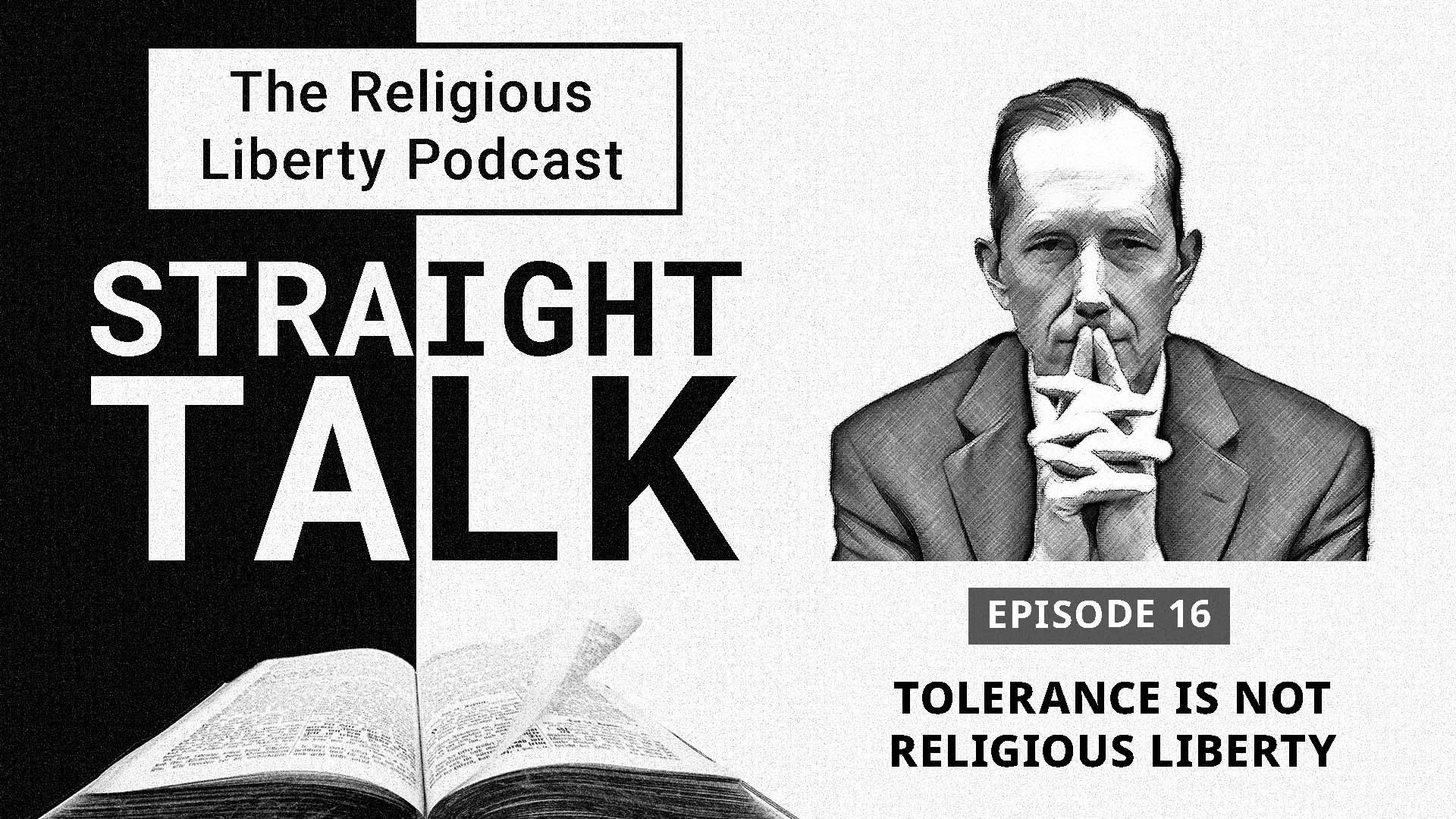
Religious tolerance is often equated with religious liberty, but these phrases do not mean the same thing. Genuine religious liberty acknowledges the fact that every person is created in God’s image and therefore has rights that cannot justly be taken away. These rights include liberty of conscience, freedom of speech, and freedom of religion. They constitute those principles that the framers of the Declaration of Independence referred to when they wrote, “We hold these truths to be self-evident, that all men are created equal, that they are endowed by their Creator with certain unalienable Rights, that among these are Life, Liberty and the pursuit of Happiness. That to secure these rights, Governments are instituted among Men…”[1] The Declaration of Independence reclaimed human identity as centered in the relationship between the individual and God, rather than between the individual and the state or the individual and the church. It laid the foundation for the United States Constitution and the Bill of Rights that defined religious liberty as a right that governments are obliged to secure and defend.
Religious toleration, on the other hand, refers to a privilege granted by the governing church or state power. This privilege is granted so long as the individual complies with certain conditions. The privilege of worship, speech, or even thought may be revoked if the conditions are not met. This definition of religious tolerance is illustrated by a few definitions from both religious and secular sources.
The United Nations’ 1995 document titled Declaration on Principles of Tolerance stated,
“Tolerance is respect, acceptance and appreciation of the rich diversity of our world’s cultures, our forms of expression and ways of being human. It is fostered by knowledge, openness, communication, and freedom of thought, conscience and belief. Tolerance is harmony in difference. It is not only a moral duty, it is also a political and legal requirement. Tolerance, the virtue that makes peace possible, contributes to the replacement of the culture of war by a culture of peace.”[2] Here, tolerance is a “political and legal requirement” to not only respect but also accept and appreciate all forms of thought, conscience, and belief. It is a secular ideology that rejects the biblical mandate to “test all things” and “hold fast what is good” (1 Thessalonians 5:21, NKJV). Taken to its logical conclusion, tolerance not only advocates respect for others, which is good, but also requires the blind and complete acceptance of every mindset, every ideology, and every political, moral, and religious system as inherently valuable and beneficial.
The Declaration on Principles of Tolerance cited numerous earlier UN documents, statements, and conventions upon which it was based. One of these, the Declaration on Elimination of All Forms of Intolerance and of Discrimination Based on Religion or Belief, included the following statement that prohibits the use of religion or belief for ends inconsistent with the goals and principles of the United Nations:
“Considering that it is essential to promote understanding, tolerance and respect in matters relating to freedom of religion or belief and to ensure that the use of religion or belief for ends inconsistent with the Charter, other relevant instruments of the United Nations and the purposes and principles of the present Declaration is inadmissible.”[3]
In other words, according to the United Nations, tolerance for someone’s religious views or observances is only admissible to the extent that they conform to the spirit and purposes of the United Nations Charter. Article 1.3 of this Declaration further clarified its definition of tolerance by stating, “Freedom to manifest one’s religion or belief may be subject only to such limitations as are prescribed by law and are necessary to protect public safety, order, health or morals or the fundamental rights and freedoms of others.”[4] In other words, you are free to exercise your religion so long as there is no law stating that you can’t. The United Nations, therefore, defines tolerance as permission granted to exercise religious beliefs only to the extent that those beliefs are determined to benefit the common good.
The common good is a concept rooted in the tradition of natural law championed by the Roman Catholic Church. This system governed Medieval Europe through church-state alliances that frequently silenced those it deemed to be religious heretics. Those that were fortunate lost their home or were forced into exile. Those less fortunate often suffered torture before being burned at the stake. During these centuries, religious freedom was granted only to those that thought, spoke, and worshiped within the defined parameters set by the church-state power. The modern concept of religious tolerance as “sympathy or indulgence for beliefs or practices differing from one’s own”[5] simply did not exist.
The Catholic Encyclopedia, in an article titled “Religious Toleration,” defends the punishment of so-called “religious heretics” during the Middle Ages.
“If in medieval times the Church adopted sterner measures against formal heretics, apostates, and schismatics than she adopts today, she did this not as a private individual, who must show only consideration and love, but as the legitimate governing authority within whose sphere also fell the administration of penal justice…. However repulsive, when judged from the more refined standpoint of modern civilization, the barbarous cruelty of medieval penal ordinances…while indeed inhuman, were not unjust.”[6]
This implementation of so-called religious toleration is perhaps better understood from secondary definitions of tolerance that include “the act of allowing something” or “the allowable deviation from a standard.”[7] Engineers use these definitions when referring to margins of error or deviance from given standards within a designed system. Anything falling within the margin of tolerance is considered acceptable and safe for the operation of the overall system. Conversely, anything found outside the tolerable parameters may be considered dangerous and a threat to the integrity or even the existence of the system. Here, religious tolerance is something that must be measured and controlled to safeguard the needs and wishes of the engineered system called society. Divergent religious beliefs and practices are allowed only to the extent that they are not perceived as a threat to the common good.
The Roman Catholic Church has never relinquished its claim to be the sole arbiter of religious truth. According to The Catholic Encyclopedia, it defends religious tolerance and religious freedom only when forced to do so by the secular power.
“When various Christian denominations establish themselves in any country, the Catholic State can no longer maintain its former exclusive attitude, but is compelled for reasons of State to show tolerance towards the heterodox and to grant them religious freedom within the limits described above and determined by natural law. If religious freedom has been accepted and sworn to as a fundamental law in a constitution, the obligation to show this tolerance is binding on conscience.”[8]Here, religious tolerance and religious freedom are granted only by compulsion and within limits “determined by natural law.” The right to belief and worship resides not with the individual, but with the governing power.
It is, perhaps, significant that the Bible has very little to say about tolerance. In the King James Version, the word “liberty” occurs 27 times and includes verses like Galatians 5:1. “Stand fast therefore in the liberty wherewith Christ hath made us free, and be not entangled again with the yoke of bondage.” Likewise, the words “free” and “freedom” are found 60 times in the King James Version. Again, these words appear in verses like Romans 8:2. “For the law of the Spirit of life in Christ Jesus hath made me free from the law of sin and death.”
However, the word “tolerance” is not found in the King James Version. Even in modern translations, it can be found only a few times when it implies a “holding back,” “delay,” or “self-restraint” on God’s part in dealing with sin: “Or do you have no regard for the wealth of His kindness and tolerance and patience [in withholding His wrath]? Are you [actually] unaware or ignorant [of the fact] that God’s kindness leads you to repentance [that is, to change your inner self, your old way of thinking–seek His purpose for your life]? (Romans 2:4, AMP).
Tolerance as a religious liberty concept cannot be found in the Bible. The Word of God speaks about liberty and freedom from sin in Christ, Christian love for those that are different from us, and the duty to share the gospel and tactfully warn others about the dangers of false worship. But tolerance as a religious liberty principle is a worldly concept. It signals either blind and silent acceptance of all religious beliefs, or control and coercion against those religious beliefs that are considered dangerous. In the end, neither definition of tolerance attempts to free people from the power of sin, and neither definition seeks after truth. Religious liberty is a right inherent to the individual, while religious tolerance is a privilege granted on condition by the ruling authority.
[1] The Declaration of Independence,” https://www.archives.gov/founding-docs/declaration-transcript
[2] Declaration on Principles of Tolerance (1995); https://www.ohchr.org/en/resources/educators/human-rights-education-training/13-declaration-principles-tolerance-1995
[3] https://www.ohchr.org/en/instruments-mechanisms/instruments/declaration-elimination-all-forms-intolerance-and-discrimination
[4] Ibid.
[5] “Tolerance.” Merriam-Webster.com Dictionary, Merriam-Webster, https://www.merriam-webster.com/dictionary/tolerance. Accessed 27 Apr. 2026.
[6] Pohle, Joseph. “Religious Toleration.” The Catholic Encyclopedia. Vol. 14. New York: Robert Appleton Company, 1912; https://www.newadvent.org/cathen/14763a.htm
[7] “Tolerance.” Merriam-Webster.com Dictionary
[8] Pohle, Joseph. “Religious Toleration.”