
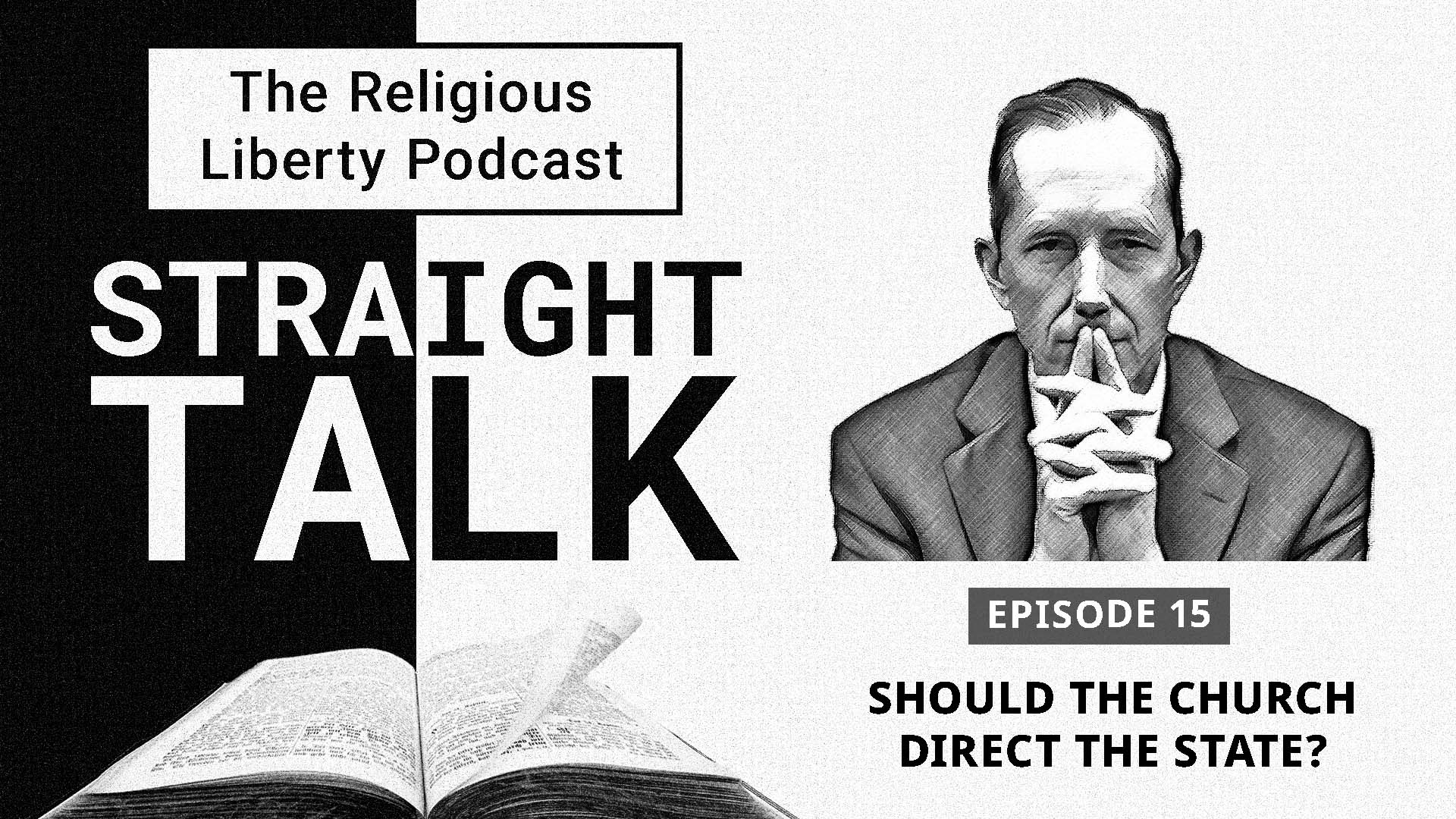
In a recent campaign for the United States House of Representatives, one candidate stated, “The church is supposed to direct the government. The government is not supposed to direct the church. That is not how our Founding Fathers intended it.” She then added, “I’m tired of this separation of church and state junk that’s not in the Constitution. It was in a stinking letter, and it means nothing like what they say it does.”[1] The comment generated enthusiastic support and heavy criticism, including a “Meet the Press Reports” episode on NBC that warned about an emerging “American theocracy.”[2]
A theocracy is a form of “government by divine guidance or by officials who are regarded as divinely guided.”[3] In theocratic societies government leaders are often members of the clergy, and the state’s legal system is frequently based on religious law. Such a form of government has long been regarded as incompatible with America’s so-called “separation of church and state.” However, a growing number of Christians now argue that the only way to save America from moral collapse is for the Church to take control of society through the legislation of explicitly Christian moral values. Supporters point to the Church’s control of European society in the Middle Ages and the theocracy of Israel in the Old Testament as models for how Christianity should govern the state today. The reasoning goes something like this: If a theocracy was good for ancient Israel, wouldn’t it also be good today? Might it even be God’s will for America? The argument is drawn from biblical precedent, so the Bible should be given authority to answer the question.
The Roots of Theocracy
God established ancient Israel as a theocracy and intended it to remain so forever. After delivering Israel from Egyptian slavery, God promised to make them “a kingdom of priests, and a holy nation” if they faithfully served Him (Exodus 19:6). For several centuries Israel operated theocratically with priests and prophets, rather than kings, leading the nation. As one historian explains,
“The government of Israel was administered in the name and by the authority of God. The work of Moses, of the seventy elders, and of the rulers and judges, was simply to enforce the laws that God had given; they had no authority to legislate for the nation. This was, and continued to be, the condition of Israel’s existence as a nation. From age to age men inspired by God were sent to instruct the people and to direct in the enforcement of the laws.”[4]
However, the Israelites eventually demanded a king so that they could be “like all the nations” (1 Samuel 8:5). God granted their request, but directed that their kings should “fear the Lord, and serve him in truth with all [their] heart” (1 Samuel 12:24). In other words, Israel’s kings were to recognize that God was still the ultimate ruler of the nation, and that they were merely sitting on the divine throne. For example, the Bible says of Solomon, Israel’s third king: “Then Solomon sat on the throne of the LORD as king instead of David his father, and prospered; and all Israel obeyed him” (1 Chronicles 29:23, emphasis added).
The End of Theocracy
As time passed, Israel’s kings rebelled against God’s authority and the divine theocracy. As a result, the Assyrians conquered and scattered the ten northern tribes, and then the Babylonians threatened Jerusalem and the two remaining southern tribes in Judah. When Zedekiah, Judah’s last king, swore allegiance to Babylon, God warned him not to rebel, “that the kingdom …might not lift itself up, but that by keeping of his covenant it might stand” (Ezekiel 17:12-14). Israel’s theocracy—and “the throne of the Lord”—depended on Zedekiah keeping his oath to Babylon.
Zedekiah did eventually rebel against Babylon, and God’s verdict was swift: “Thus saith the Lord GOD; Remove the diadem, and take off the crown: this shall not be the same: exalt him that is low, and abase him that is high. I will overturn, overturn, overturn, it: and it shall be no more, until he come whose right it is; and I will give it him” (Ezekiel 21:26, 27). God removed the divine throne from Israel and ended the theocratic form of government “until he come whose right it is.”
So who would the promised king be? The Bible identifies Jesus Christ as the King that will again sit on God’s throne. An angel announced to Mary, “[T]hou shalt conceive in thy womb, and bring forth a son, and shalt call his name JESUS. He shall be great, and shall be called the Son of the Highest: and the Lord God shall give unto him the throne of his father David” (Luke 1:31, 32). When will Jesus sit on the throne? Jesus told His disciples, “[I]n the regeneration when the Son of man shall sit in the throne of his glory, ye also shall sit upon twelve thrones, judging the twelve tribes of Israel” (Matthew 19:28). Jesus will sit on God’s throne on earth in the “regeneration” after sin has been destroyed and God “make[s] all things new” (Revelation 21:5).
The Church’s Mission
For over 2,500 years, no legitimate theocracy has existed on earth, and this means that God has never authorized the Christian church to govern the state. Jesus did not try to control human politics, but told the Roman governor Pilate, “My kingdom is not of this world: if my kingdom were of this world, then would my servants fight…To this end was I born, and for this cause came I into the world, that I should bear witness unto the truth. Every one that is of the truth heareth my voice” (John 18:36, 37). The Church’s mission is not to fight—literally or politically—to establish a “Christian nation.” It is to live like Jesus—to help those in need and to teach and preach Bible truth.
So why does this matter? Bible prophecy predicts four world empires—Babylon, Medo-Persia, Greece, and Rome—between Zedekiah, the last king of Judah, and the second coming of Jesus Christ. Soon after Babylon conquered Judah, God said through the prophet Ezekiel, “I will overturn, overturn, overturn” the kingdom before a legitimate king again sits on the throne (Ezekiel 21:26, 27). When the Medes and Persians conquered Babylon, the kingdom was “overturned” the first time. The kingdom was “overturned” a second time when Alexander the Great and his Grecian army defeated the Persians. The Roman Empire “overturned” the kingdom the third time. According to Bible prophecy, Rome will exist in some form until Jesus Christ returns and “the Son of man [sits] in the throne of his glory” (Matthew 19:28). God will set up His kingdom on earth after Jesus returns, not before then. Any attempt now on the church’s part to control politics will inevitably result—as it has so many times in the past—in the control of conscience and the eventual disappearance of religious liberty.
1 https://www.washingtonpost.com/politics/2022/06/28/lauren-boebert-church-state-colorado
2 “Theocracy Rising & Money In Politics: Meet the Press Reports.” https://www.youtube.com/watch?v=BLhzOI3iAG0
3 “Theocracy,” Encyclopedia Britannica; https://www.britannica.com/topic/theocracy
4 Ellen White, Patriarchs and Prophets, p. 603